Free AI Ring Design Generators and Their Limits
Free AI ring tools make images, not castable files.

Free AI ring design generators help with trying out ideas, but most make pictures or uneditable meshes rather than the controlled geometry needed for casting. For designers and retailers, the useful distinction is where each output stops and what must happen next. A render that looks convincing can get a client to approve a design. It cannot, by sheer force of sparkle, become a manufacturing file.
Why free AI ring tools sit at opposite ends of the design-to-manufacturing pipeline
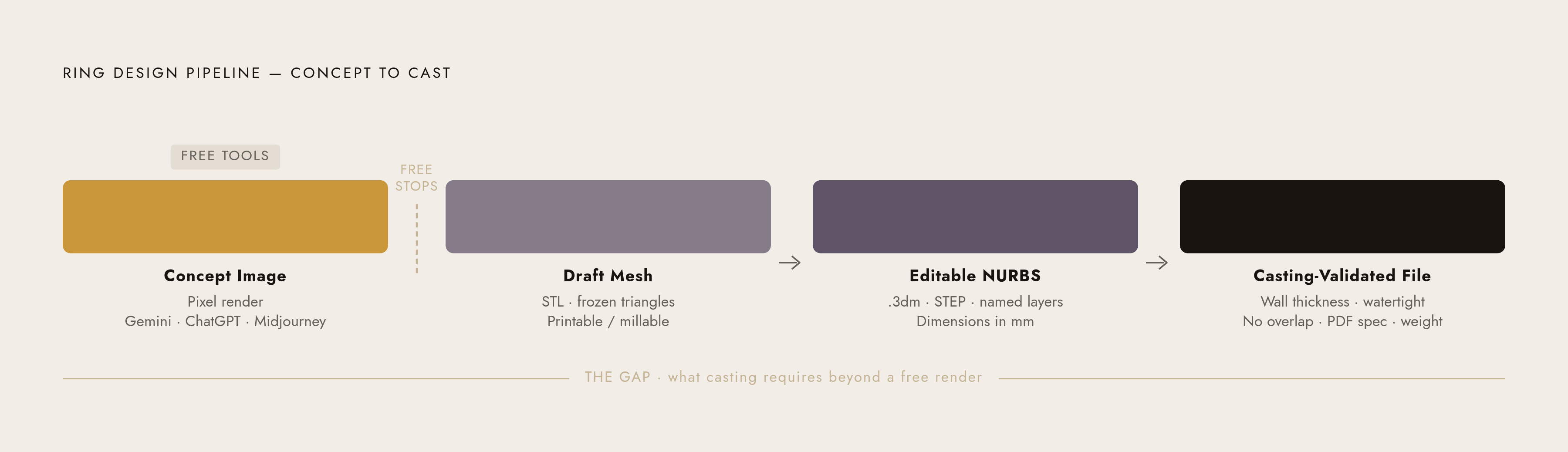
The market puts two different kinds of tools under the same label. Image generators, including Gemini, ChatGPT, and Midjourney, produce pixels from training on photographs of finished jewelry. Geometry producers make models in formats such as STL, STEP, or native.3dm. They are a much smaller group, and reaching those outputs almost always requires a paid tier.
A concept render helps a client and designer agree on a visual direction, while a production-ready model gives a manufacturer the geometry needed to make it. Both have a place in custom work. The expensive mistake is treating approval of the first as completion of the second, because the dimensional engineering still has to happen somewhere.
What casting actually requires from a file, and why most free outputs don't meet it
An image fails the manufacturing test before anyone inspects its design. It contains no geometry for a casting house to use. An STL does, but it is a frozen triangle mesh that can be printed or milled and is accepted by casting houses. It does not preserve editable parts, so changes such as resizing a shank, swapping a head, or adjusting stone seats can require rebuilding the original design.
A native.3dm NURBS file serves a different purpose. It holds editable surfaces, with prongs, seats, shanks, and bails as separate named objects on layers. FormaNova’s CAD page contrasts that structure with a generated mesh, which is one fused shell, often unitless, with stones represented as surface bumps. Its NURBS models instead have separate parts, gem bodies in seats, and dimensions in millimeters.
File format is only the first production gate. For geometry to be castable, it also needs a closed watertight solid, walls that meet minimum thickness, no overlap between stone and metal, and stones that are properly seated. Free image tools never run those checks because they produce no geometry to inspect. Even AI tools that make models still need a person to check settings and wall thickness, so a hybrid workflow is still needed in 2026.
What the free tier of each major image generator actually produces
Gemini and ChatGPT offer free image generation that is useful for exploring ring concepts and communicating with clients. Their output is a render without dimensional control. They understand jewelry vocabulary well enough to show a recognizable direction before CAD work begins. At that stage, visual agreement is the job. The prong geometry, stone count, band dimensions, and setting construction still need review and technical definition before fabrication.
As of October 2026, it has no free trial, and its Basic plan starts at a low monthly fee. Its stylized mood images are well suited to concept art. Images are public by default on midjourney.com, and keeping them private through Stealth mode requires Pro or Mega, with prices starting at $60/month.
getimg.ai’s design page explains that a sketch can guide how a design looks without automatically turning into an accurate CAD reconstruction. Sizing and tolerances are defined in CAD. A sketch can tell the generator what the ring should resemble. It does not turn a good resemblance into a set of manufacturing dimensions.
Jewelry-specific generators that add a 3D output tier — and what that tier actually delivers
Jewelry-specific tools can offer a route beyond pictures, but “3D output” describes several different destinations. Tashvi AI’s free plan starts the design process, while its Basic plan adds a draft STL. Its $60 Pro plan adds Parametric Studio Beta, which has casting checks and can export STEP/STL. Because the parametric offering is a beta, a CAD professional should still validate its output before production.
FormaNova describes a more direct text-to-CAD and image-to-CAD workflow. It accepts descriptions, images, sketches, or inspiration photos and delivers an editable native.3dm that opens in Rhino, plus STEP and STL. Every piece passes a FormaNova reviewer before delivery. The service also runs checks for watertight solids, minimum wall thickness, and zero stone-metal overlap on every model.
Each delivery comes with a PDF technical specification sheet and the metal weight worked out in grams and DWT for each metal type. Its scope includes rings and other jewelry, from earrings and pendants to bracelets and watch cases. A draft mesh is a frozen shell, while named NURBS parts let a bench jeweler change the design without remaking the whole thing.
Where agentic and parametric CAD sits in this landscape right now
Agentic CAD moves AI inside a parametric environment, where agents generate and validate CAD instructions. That is a meaningful change in capability. But it remains an active research frontier rather than a production-stable workflow for most jewelry businesses today.
Agentic parametric CAD is a direction the technology is moving. Tools reaching that level today are not free and require real CAD knowledge to use productively. “Coming” and “available at no cost” occupy different drawers.
How e-commerce ring configurators differ from both image generators and CAD tools
Retail configurators solve a customer-facing problem that neither concept generation nor standalone CAD addresses on its own. They let customers configure a ring on a website, see a price, and move toward an order. Ring Facet costs $70/month on Shopify and offers real-time 3D customization of shape, metal, and setting, plus quote mode and save-and-share. Keyideas Jewelith provides interactive 3D visualization across Shopify, WooCommerce, and other platforms. These tools help make the sale tangible.
Other options have different pricing and integration models. Zakeke costs $69.90–$299.90/month, plus a fee for each order that depends on the plan. Kickflip costs $59/month plus up to 1.95% per custom product and integrates with Shopify, WooCommerce, Wix, BigCommerce, and a custom API. Threekit uses quote-only enterprise pricing for large catalogs.
If a wholesale diamond feed changes overnight but the builder does not reflect it, the retailer must absorb the difference or cancel the order. Star Gems launched Ring Studio in July 2026 for independent retailers who sell engagement rings online without keeping physical inventory, with live AI-powered pricing for the different configurations. Berco Jewelry’s builder offers real-time pricing updated nightly to the gold market, with the retailer setting the markup.
Most app-tier configurators lack the constraint enforcement and topology validation required for parametric, castable geometry, so they hand over a visual reference that still needs separate CAD work. Implementation also takes time. A standard Shopify or WooCommerce jewelry site takes roughly 8–14 weeks to build, but a ring builder or 3D configurator brings that to roughly 14–22 weeks. The subscription is only one part of that commitment.
The production handoff step that free tools skip and what it actually costs
Starting with a free image or basic configurator leaves a separate CAD and casting step to fund. The cost depends on design complexity, the provider, and revisions before the geometry passes casting checks. Across CAD plus casting, the range can span two orders of magnitude. “Free design” Free design” therefore describes the starting tool. The missing work is budgetable once it is named.
Guru Diam’s November 2026 pricing puts a concrete number on one route. The trade-only service in New York’s Diamond District offers ring CAD at $30, with approximately 24-hour turnaround, and full casting and finishing in 4–6 working days. AurumFlow lists CAD in 1–5 business days at a mid-range price in its November 2026 rate information. After approval, its US casting houses cast, set, finish, and inspect in 5 business days. The approval point separates design time from the manufacturing schedule.
Specialty Casting’s prices for 3D CAD vary widely with the project. CAD/CAM Designs offers CAD-only from a modest base price, design plus print from a slightly higher starting point, and full manufacturing from a substantially higher base. Its premium halo/pavé ring work costs considerably more for CAD alone and several times that for full manufacturing.
Casting House in Chicago handles fine casting, CAD/CAM design, and bridal jewelry, primarily for independent jewelers commissioning one-off and small-batch custom work. MKM Jewelry in Los Angeles provides in-house CAD, 3D wax printing, lost-wax casting, mold making, diamond setting, laser engraving, and finishing. These services supply the production work that a concept tool leaves open. The lowest-friction connected workflow goes further, delivering validated CAD and a deterministic price to production together without a human quoting step, which basic configurators and image tools do not provide.
Matching the right tool to the right job in the design-to-casting workflow
The practical choice starts with the next required output. For a client conversation, Gemini or ChatGPT can provide a fast, free way to show a direction before commissioning CAD. Both parties should understand that the render is a conversation starter. For exploration with a path toward geometry, Tashvi offers staged access from a free design plan to a draft STL and then its parametric beta. That last route still needs a professional to check the model before it goes into production.
For an editable manufacturing handoff, FormaNova’s text-to-CAD or image-to-CAD workflow supplies named NURBS parts, casting-validated geometry, a specification sheet, and metal weight. Its native.3dm is in the format that trade manufacturers including Stuller prefer. A business needing a model that can be adjusted by part has a different requirement from one seeking approval of a visual concept.
For a retail website, Ring Facet, Keyideas Jewelith, VDB Ring Creator, or Kickflip addresses customer configuration and order capture. A production CAD file is still needed separately unless the platform exports geometry that has been validated. For businesses that want the whole chain, the market is moving toward AI platforms built for jewelry that link parametric design, live pricing, and manufacturing handoff. These platforms add value through dimensional engineering, casting validation, and order-to-file automation as well as an attractive render.
A designer may need a picture, a retailer may need an order, and a caster needs controlled geometry. Choosing for that handoff makes free tools useful without asking them to perform a job they never promised to do.